How John Neff Crushed The Index Over Three Decades |
John Neff is an unknown name for most investors. That is partly because he retired back in 1995, but mainly because he lived most of his life in a humble suburb of Philadelphia away from the noise on Wall Street.
His results speak for themselves, though. Over the 31 years Neff ran the Windsor Funds, he delivered 13.7% annual returns. By the end of his tenure, the fund had become the largest mutual fund in the U.S. These are extraordinary achievements.
Over the same 31 years, the S&P 500 returned 10.6% annually. According to his book, John Neff on Investing, the 3.1 percentage point in annual outperformance was net of fees and the fund’s gross returns were actually closer to 3.5 percentage point better than the index on average annually. As we know about the magic of compounding, even a few points of outperformance make a difference over time. Over the 31 years, John Neff turned $1 into $56. A $1 investment in the S&P 500 in the same years would yield $22. Needless to say, Neff made a lot of people rich over his career. While Neff’s numbers are impressive, the way he did it should really resonate with retail investors. Most of his methods, including being independent and staying away from overpriced growth, are very replicable for amateurs.
With that, let’s dive into John Neff’s investment approach: Brought to you by: Stock Unlock. |
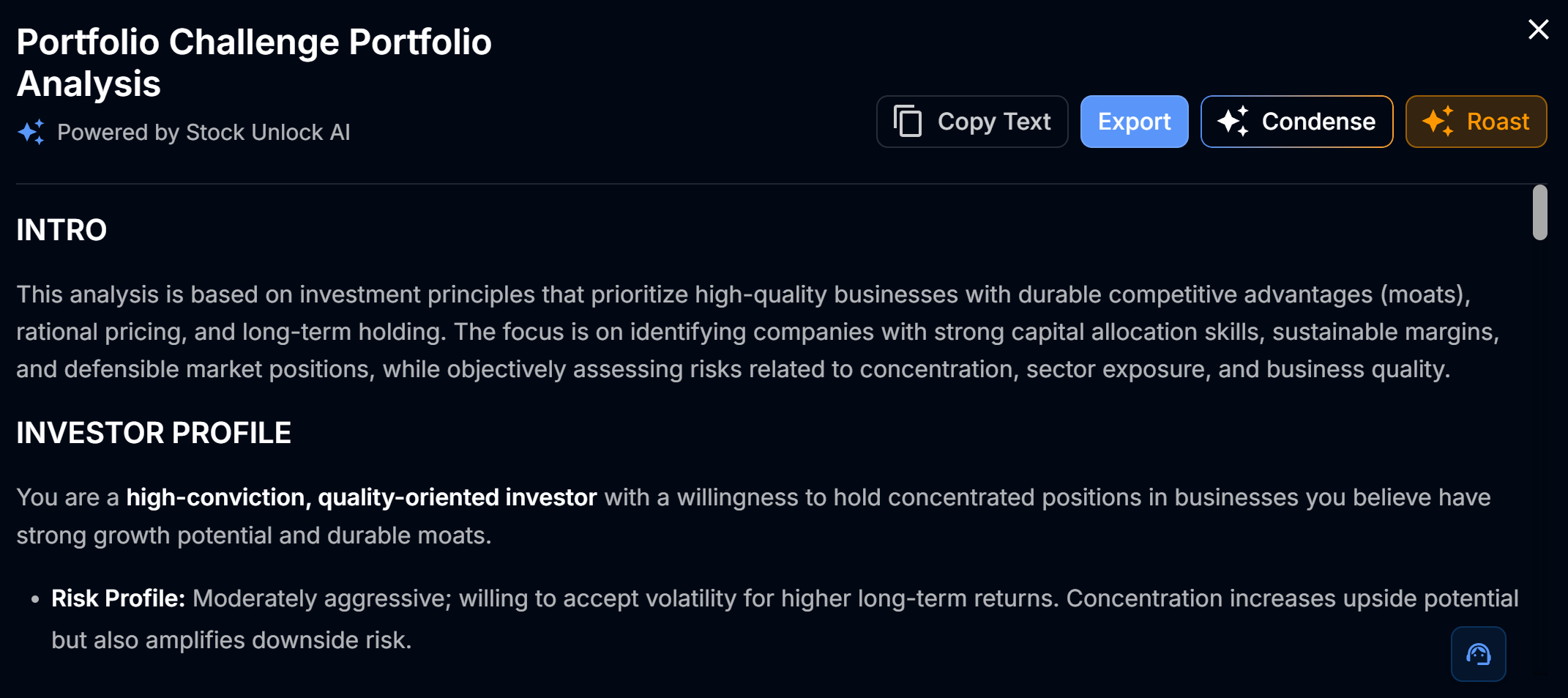
✨ New Feature: AI Portfolio Analysis
|
You can now generate a full AI-powered analysis of any portfolio directly from the Stock Unlock website. This includes investor profile insights, concentration and risk breakdowns, position-level commentary, and one-click export.
This feature is currently available only on desktop and mobile web, with the app version coming soon.
🤖 Download Android App Here
🍎 Download iOS App Here |
|
|
“Eventually, good stocks of good companies with solid earnings and low price-to-earnings ratios receive the attention they deserve. With patience, luck, and sound judgment, meanwhile, you keep moving forward.” Neff is a value investor by heart. In the 1960s, value investing was characterised by “net-nets” and buying stocks at prices lower than their net asset values. However, Neff makes no mention of net-nets in his book and by no means was buying ultra cheap stocks the secret to his success.
Instead, Neff was in many ways ahead of his era when he realized that buying companies solely because they trade at a low P/E was going out of fashion. He also demanded certain growth rates to go with the low earnings multiples, which, as we will see soon, often meant taking a contrarian approach to what the market offered. It has never been easy to find cheap stocks with growing earnings without there being some sort of catch, and that was also the case when Neff was active.
In his book, Neff sums up his seven most important investment principles: -
Low P/E Ratio
- Fundamental Growth >7%
- Yield Protection
- Superior Relations of Total Return to P/E Paid
-
No Cyclical Exposure Without Compensating P/E
- Solid Companies in Growing Fields
- Strong Fundamental Case
There is arguably nothing groundbreaking about these principles, which, if anything, shows investors that the consistent application of simple rules can get you very far over the long run. Most of us can attest that sticking to your investment principles has been hard in recent years where the market has valued growth highly (and even growth investors had to suffer through a big downturn in 2022). So, to do it over many decades could not have been easy.
Regardless, there are some interesting points to click on. Instead of demanding a P/E multiple below an arbitrary number, say 15x, Neff wants a sufficient multiple to go with the total return he expects.
What that means is that earnings multiple Neff is willing to pay depends on the earnings growth and dividend yield. So while Neff likely looked at valuation as very important, he was not so set in his ways that he stayed away from companies growing at double-digit rates even if it meant paying more. Neff called it a “Total Return Ratio”. If the expected return (growth + yield) is 15% and the P/E is 15x, the ratio is 1 (15 divided by 15). Neff wanted a ratio that was twice as big as the market.
In today’s market, with the S&P 500 currently trading at around 28x and the expected return being 10% (9% earnings growth + 1% dividend yield), the total return ratio is 0.35. This means Neff would be looking for something along the lines of 14% growth at a 20x P/E multiple for a total ratio of 0.7 (again, double of what the market offers).
Of course, it takes a good bit of experience and intuition to know what the right multiple to pay is. But this principle is one the most important one to remember in the stock market. Investors who paid too much relative to growth have been burned in recent years, and demanding a “superior relation of return to P/E paid” is the best way to avoid overpaying. |
Growth, But Not Too Much Growth |
“Almost routinely, in the aftermath of excessive overvaluation, there is a compensatory penalty on the downside.”
Despite the value investor tag to Neff’s name, he also frequently invested in growth stocks when they were available at reasonable prices. However, he made a point to never invest in companies growing faster than 20% because these often had more risk to them than he was willing to accept. So while Neff does not mention anything about circle of competence or certain industries he preferred to hunt in, he clearly stayed within a “circle of growth rates” which kept him away from high flyers.
On the other hand, Neff liked a segment he called “less recognized growth”. In 1974, the stock price of a specialty retailer named Edison Brothers had declined because the company tried to diversify into adjacent categories. The market did not initially reward the stock as the company got back to itself and returned to growth, which led Neff to add it to his portfolio. When Neff sold the stock a little more than a year later, Windsor had gathered a 137% gain.
Neff says in his book that he tended to have around 25% of the fund’s assets in this category of less recognized growth, which shows his ability to hunt in both value and growth camps. |
“Taking the unpopular view was how we made our money.”
The first examples of Neff’s ability to act contrary to the crowd came in the early 1970s. Back then, the famous Nifty Stocks were bid up to exuberant prices, and companies like Coca-Cola and McDonald’s were trading at more than 50-60x earnings.
Neff refused to partake in this, but suffered through pretty deep underperformance for several years as a result. In fact, Windsor Funds underperformed by a total of 26 percentage points between 1971 and 1973.
Two to three years of significant underperformance would have most of us reconsider our principles, or at least experience some sort of FOMO to own the richly valued companies that dominated the market. In many ways, today’s environment is not too different from early 1970s.
However, the Nifty Fifty bubble eventually burst. Neff, having stuck to his principles, outperformed the market by 63 percentage points between 1974 and 1976. Being contrarian is clearly not only about buying unpopular stocks, it is also about sticking to your principles and not blindly following the crowd into what is popular.
Neff certainly also bought cheap stocks that the market despised. In the years leading up to 1984, Ford had suffered billion dollar losses from declining sales and signs that the U.S. automaking industry was under threat from imports. Neff bought Ford at just 2.5x 1984 earnings on the opinion that Ford had strengthened its balance sheet and that it had a good brand abroad to make up for slowing domestic sales. As an extra layer of protection, Ford also paid a 5% dividend.
At that earnings multiple, a few positive news headlines was all it took for the stock to rebound. As the economy improved and gas prices fell into 1985, Neff sold Ford for an 85% gain by the end of the year.
It’s also important to mention that Neff believed the crowd was right in most cases. There is a fine line between being contrarian and just being stubborn, and taking a contrarian approach just for the sake of it will likely lead to being wrong more often than being right. As Neff explains, acting contrarian means keeping your mind open. The fundamentals are ultimately what matters. |
This is worth touching on because having the right temperament seems to be among the common traits of many of the best investors. For one, Neff grew up in Ohio and apart from early in his career, did not work on Wall Street. This humility and independence is famously shared by Warren Buffett (who has operated Berkshire out of Omaha for decades), but also other investors who have beaten the market over the long-term, such as Dev Kantesaria of Valley Forge (residing in Florida) and Chuck Akre (Middleburg, Virginia).
The big question is whether such temperament in an innate trait or if it is possible to develop. In Neff’s case, he read the Wall Street Journal every week and frequently met with analysts from other brokers to discuss stocks. He certainly did not stay away from what was happening on Wall Street, but he had the discipline and temperament to reflect on what he heard and come to his own conclusions. |
Anyone beating the market over more than three decades should be studied in detail. Neff did this not through the conventional “buy and hold” approach, but rather by sticking to his own principles and buying growing companies when they were available at decent prices.
Some of the companies he invested in had elements of cyclicality to them, but many of them were retailers or former growth stocks that had sold off for all possible reasons. Neff was willing to go through the fundamentals, have an opinion about when the cycle would turn or why a company would grow faster than the market anticipated, and made a lot of money by being more patient than other investors.
Looking back at some of the opportunities in recent years across cyclicals (semiconductors in 2022) and large caps (Meta and Netflix), the opportunity set today is not much changed from what it was in the 1970s and 80s. Neff earned one of the most impressive track records out there by finding these companies, applying his principles, and making independent decisions on when to buy and sell. Seems simple, but definitely not easy to execute day in and day out over three decades.
|
|
|
This Newsletter's Author
This newsletter was written by Jørgen Pettersen. You can find him on Twitter/X. |
|
|
Stock Unlock's newsletter is not a recommendation to buy or sell stocks. Stock Unlock does not provide financial advice, and we are writing this newsletter to help share ideas and teach you more about stock analysis. Please do not buy or sell stocks we discuss without doing your own research and/or consulting with a professional. |
|
|
In addition to providing education around investing fundamentals we are exploring adding value through sending our members stock ideas and analysis. Please let us know if you enjoy this type of newsletter or have any feedback. Let us know what you think by emailing support@stockunlock.com |
|
|
📱 Now Available on iOS and Android |
|
|
Join 4,000+ Investors on Discord |
| |
|
Connect with us on LinkedIn |
| |
|
|
_01KC9YGZA223M7AVB2M470MV3G.jpg)