
How to Choose a Discount Rate for a DCF (With Real Examples)

By Brian McCormick ·

There is no single “correct” discount rate for a DCF.
For an individual investor valuing a stock, I think the most useful way to think about the discount rate is as the annual return you require to make the investment worthwhile.
If you would only buy a stock if you believed it could return at least 10% per year, something around 10% is a logical starting point. An investor demanding 12% should use 12%.
That choice has a surprisingly large effect on the valuation.
A higher discount rate means you are willing to pay less today. A lower discount rate means you are willing to pay more.
Because the effect compounds, moving from 10% to 12% can change fair value by much more than the two percentage point difference might suggest.
Traditional corporate finance approaches the question somewhat differently. Depending on which cash flows a DCF is valuing, the appropriate rate may be a company's weighted average cost of capital, or WACC, or its cost of equity.
Both approaches are useful. They are answering slightly different questions.
What a Discount Rate Actually Means
Imagine someone promises to give you $100 ten years from now.
You probably wouldn't pay $100 for that promise today. Money in your hands now could be invested elsewhere for the next decade, and there is also some uncertainty around whether that future payment arrives.
You therefore work backward from the return you require.
At a 10% annual return, $100 received ten years from now is worth only about $38.55 today.
The basic formula
Present Value = Future Value ÷ (1 + Discount Rate)^Years
Here is what happens to that same $100 payment as your required return changes:
• 8% required return: $46.32 today
• 10% required return: $38.55 today
• 12% required return: $32.20 today
• 15% required return: $24.72 today
The future payment is still $100 in every case.
What changed is how much you are willing to pay for it today.
A DCF does essentially the same thing with a business. You estimate cash flows or a value that the company may produce in the future, then convert that future money into today's dollars.
So What Discount Rate Should You Actually Use?
For the kind of DCF an individual investor might run in StockUnlock, I would generally start with the return I actually want to earn.
Something around 10% can be a useful baseline for testing a stock, although I wouldn't treat 10% as some universal investing law.
A simple way to think about the range:
• 8%: You are willing to accept a relatively modest equity return
• 10%: You want roughly a solid long term equity return
• 12%: You require a meaningfully higher return before buying
• 15% or more: You need a very large return to justify the investment
StockUnlock's DCF calculator makes this interpretation fairly explicit. The input asks:
What Rate of Return Do You Want?
I like that framing because it gets directly to the economic question behind the valuation:
Suppose your assumptions about the company are right. How much can you pay for the stock today and still earn the return you want?
That tends to be more useful for an individual investor than spending an enormous amount of time debating whether a company's mathematically estimated WACC is 8.3% or 8.7%.
What Happens If You Change the Discount Rate on a Real Stock?
Microsoft gives us a good example.
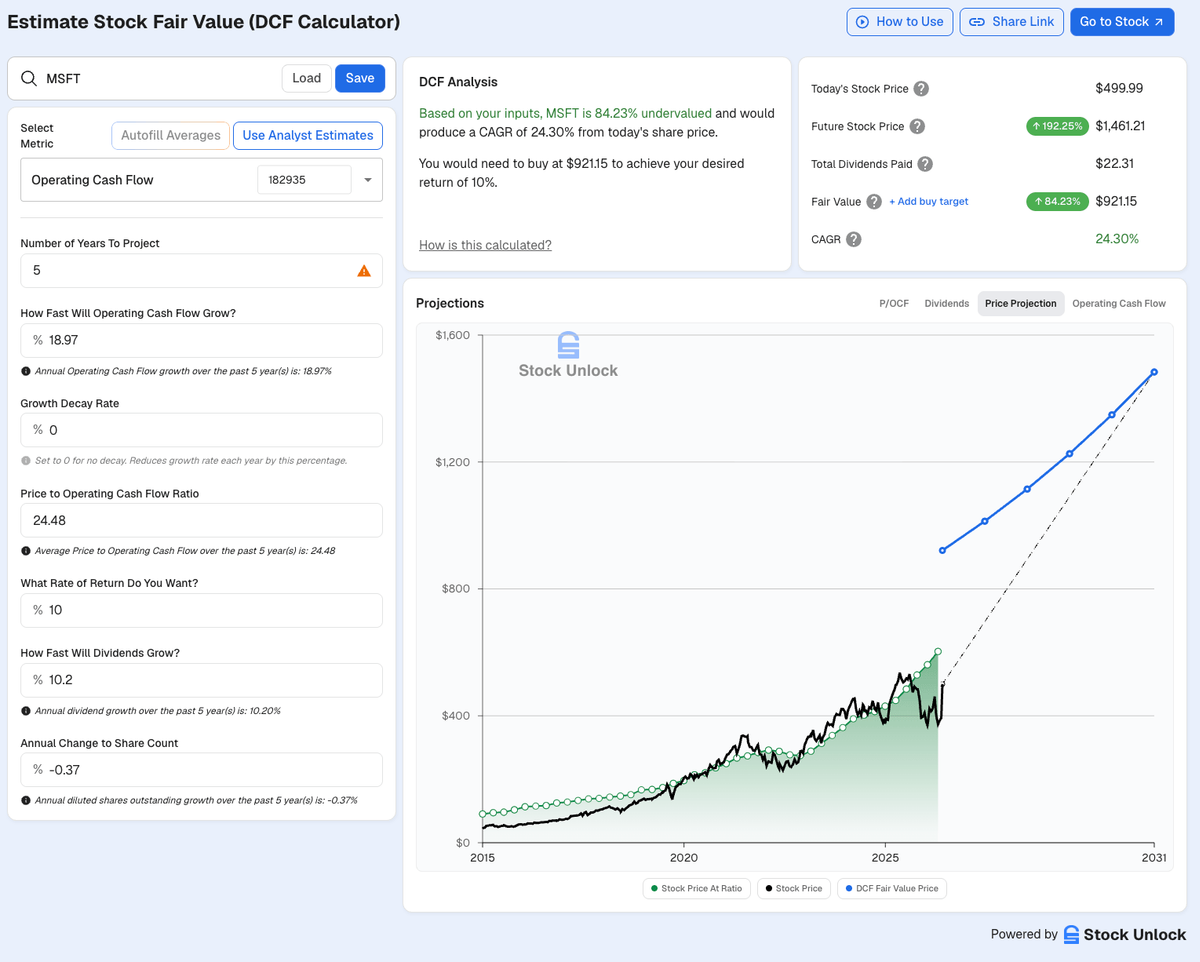
In this StockUnlock Microsoft valuation scenario, the model uses:
- Current operating cash flow: $182.935 billion
- Projection period: 5 years
- Operating cash flow growth: 18.97% per year
- Growth decay rate: 0%
- Price-to-operating-cash-flow multiple: 24.48x
- Required return: 10%
- Dividend growth: 10.2% per year
- Annual change in share count: -0.37%
At 18.97% annual growth with no decay, Microsoft's operating cash flow would rise from about $182.9 billion to $436.0 billion over the five-year projection.
Using those assumptions, StockUnlock estimates:
- Future stock price: $1,461.21
- Total dividends paid: $22.31
- Fair entry price at a 10% required return: $921.15 per share
The model is essentially saying that the future stock price plus dividends would be worth about $1,483.52 five years from now.
At a 10% required return, you work backward:
$1,483.52 ÷ 1.10⁵ = $921.15
Now leave everything else in the model alone.
The operating cash flow forecast does not change. Neither does the valuation multiple, future stock price, dividends, or projection period.
Only the return you demand changes.
Microsoft at different required returns
- 8% required return: About $1,010 per share
- 10% required return: About $921 per share
- 12% required return: About $842 per share
- 15% required return: About $738 per share
That is a much easier way to see what is happening.
An investor requiring an 8% annual return could justify paying roughly $1,010 under these assumptions. Raise the hurdle to 12%, and the fair entry price falls to about $842.
One assumption creates almost $168 of valuation difference
That is nearly a $168 difference per share without changing a single assumption about Microsoft's underlying business.
Microsoft did not suddenly become a worse company.
The investor simply demanded a higher return.
This is why I don't think a DCF should be viewed as a machine that spits out one objectively correct intrinsic value. The result is conditional on what you put into it.
There are also plenty of other DCF limitations that can make a valuation wrong, including unrealistic growth, margin, reinvestment and terminal value assumptions.
Longer Forecasts Make the Discount Rate Matter Even More
The Microsoft example shows how much the discount rate can change a valuation even over five years.
Stretch the forecast to ten years and the effect becomes much larger.
Take Amazon.
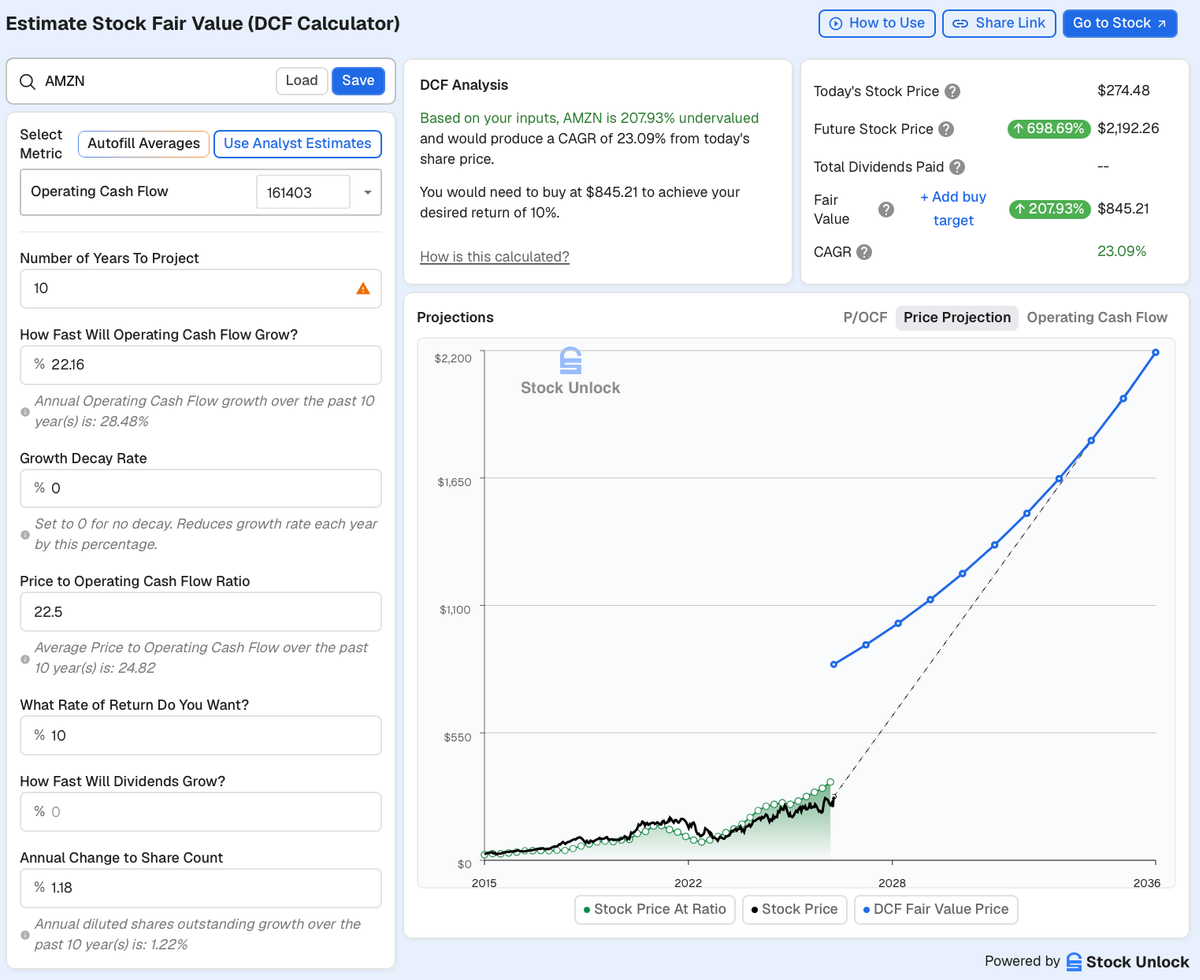
In this StockUnlock scenario, Amazon's current operating cash flow of about $161.4 billion is projected forward for ten years using 22.16% annual growth, a 22.5x price-to-operating-cash-flow multiple, and a 1.18% annual increase in the share count.
That produces an estimated future stock price of $2,192.26.
What matters here is that the $2,192 sits ten years away.
At a 10% required return, you wouldn't pay anything close to $2,192 for that future value today. Discounting it back over a full decade gives you a fair entry price of about $845 per share.
Change the return requirement and the gap gets wide pretty quickly:
- 8% required return: about $1,015 per share
- 10% required return: about $845 per share
- 12% required return: about $706 per share
- 15% required return: about $542 per share
That is a range of nearly $474 per share between an 8% and 15% required return.
And nothing about the Amazon forecast changed.
The same $2,192 future share price is sitting at the end of every scenario. The only difference is how aggressively you're discounting ten years of waiting.
This is where the compounding starts to matter much more than the percentage points make it sound.
An 8% versus 12% required return is only a four-point difference on paper. Over ten years, though, it changes the amount you can pay today from roughly $1,015 to $706.
That's more than a 30% lower entry price.
For businesses where a large part of the investment case depends on what they may earn many years from now, I would pay particular attention to this. A DCF can look very attractive at one discount rate and much less so after only a modest change in the return you require.
The further away the payoff is, the less innocent that discount-rate assumption becomes.
Should Riskier Companies Get Higher Discount Rates?
Traditional finance generally says they should.
Investors normally expect more return for taking more risk. In a conventional valuation framework, the cost of equity may be estimated using a risk free rate, an equity risk premium, and some measure of the stock's risk.
When valuing cash flow available to both shareholders and lenders, analysts commonly use WACC.
That is financially sound.
But I think individual investors need to be careful about how many places they insert the same risk into a model.
Imagine you are skeptical that a company's 25% growth can continue.
You have a few ways to reflect that concern.
You could keep the 25% growth assumption and compensate by using a much higher discount rate.
I would often rather challenge the growth assumption directly.
Maybe a more realistic model has growth fading toward 12%. If today's valuation multiple also looks unusually rich, you can lower the terminal multiple.
Once those more conservative assumptions are already in the DCF, dramatically raising the discount rate may end up penalizing the company for the same uncertainty twice.
There isn't one mandatory way for an individual investor to handle this.
Consistency matters more.
Know where you are accounting for risk and avoid quietly inserting the same concern into every assumption.
WACC vs. Required Return: Which Should You Use?
The answer depends on what you are valuing.
Here is the simplest way to remember it:
• FCFF or enterprise DCF: WACC
• FCFE or equity DCF: Cost of equity
• Investor return model: Your required return
The important thing is matching the discount rate to what the model is actually valuing.
Use WACC when valuing the entire business
A traditional free cash flow to the firm DCF estimates cash available to both debt and equity investors.
Both groups supplied capital, so the discount rate generally reflects the cost of both.
In simplified form:
WACC = Cost of Equity × Equity Weight + After Tax Cost of Debt × Debt Weight
Calculating it properly requires estimates for things such as beta, the equity risk premium, borrowing costs, tax rates, and the company's market value capital structure.
It is the conventional approach when you are trying to estimate enterprise value from cash flow to the entire firm.
Use cost of equity when valuing shareholder cash flows
A model estimating free cash flow directly to equity investors generally uses the cost of equity instead.
This is really a matching problem:
• Equity cash flow: Use cost of equity
• Cash flow to the whole firm: Use WACC
Mixing the two can distort the result.
Use a required return when asking what you should pay
This is the approach I find most intuitive for many individual investors.
The process is pretty simple.
1. Project the business
Estimate what the company might reasonably generate.
2. Estimate what the shares could eventually be worth
Use your assumptions about growth, margins, valuation, share count, and other factors.
3. Choose the return you require
Maybe that is 8%, 10%, 12%, or something else.
4. Work backward
Calculate how much you can pay today and still earn that return if your scenario plays out.
StockUnlock's calculator is built around this idea. It projects a financial metric, estimates a future share value using a valuation multiple, incorporates dividends and changes in the share count, then discounts that future value back to today.
Instead of asking for an abstract intrinsic value, you end up with a more practical question:
How much can I pay today if this scenario happens and I still want a 10% annual return?
Don't Use the Discount Rate to Make the DCF Say What You Want
This is one of the easiest ways to make a DCF useless.
Imagine you model a stock you already like and the valuation comes out lower than expected.
You start with a 12% required return.
The valuation looks too low.
So you try 10%.
Still not enough?
Try 8%.
Eventually there will probably be some rate that produces the valuation you wanted in the first place.
You can do the same thing in reverse with a company you dislike. Keep raising the required return and nearly any stock will eventually look expensive.
At that point, the discount rate isn't expressing your investment hurdle anymore. It has become another knob for steering the model toward a predetermined conclusion.
I prefer deciding what return I require before becoming attached to the final valuation.
If my hurdle is 10%, I want to know what the business is worth at 10%, even when I don't like the answer.
Then I can spend my time on the more interesting question:
Are the business assumptions necessary to justify today's price believable?
A Higher Discount Rate Is Not the Same Thing as a Margin of Safety
These concepts are related, but I wouldn't combine them.
Suppose:
• DCF fair value: $100 per share
• Required return: 10%
• Desired margin of safety: 20%
You might refuse to buy above $80 per share.
$100 fair value × 80% = $80 maximum purchase price
The two assumptions are doing different jobs.
• 10% required return: The annual return you require if your scenario plays out
• 20% margin of safety: Extra protection against the possibility that your scenario is wrong
You could instead keep increasing the discount rate until the DCF itself produces $80.
But now two separate judgments have been buried inside one number.
It becomes harder to tell whether your valuation changed because you require a higher return or because you're worried about forecasting error.
Keeping those assumptions separate makes the model easier to reason about later.
Run a Sensitivity Analysis Instead of Pretending You Know the Exact Rate
I wouldn't spend too much time trying to determine whether 9.5%, 10%, or 10.5% is the precisely correct discount rate.
Run all three if you care.
Better yet, widen the range enough to see whether the conclusion actually changes.
For a normal sensitivity check:
• 8% required return
• 10% required return
• 12% required return
If you are targeting particularly high returns:
• 10% required return
• 12% required return
• 15% required return
Then do something similar with the operating assumptions.
Test what happens if:
• Growth comes in lower than expected
• The terminal multiple compresses
• Margins don't expand as much as you hoped
• Share dilution is greater than your base case
A useful DCF shows you how those changes interact.
The question gradually shifts away from:
What is this stock worth?
Toward something I find much more useful:
What has to happen for today's stock price to make sense?
Think in ranges
You don't necessarily need one answer.
You may have a conservative scenario, a base scenario, and a more optimistic scenario.
Then you can see how each of those behaves at several required returns.
For example, imagine testing the same stock across a few different growth assumptions and required returns.
The general pattern is pretty simple:
• Lower growth and a higher required return produce the lowest valuation
• Base growth and a 10% required return give you your central case
• Higher growth and a lower required return produce the highest valuation
Most of the other combinations will fall somewhere in between.
The exact numbers will be different for every stock. What matters is whether your investment thesis survives reasonable changes in the assumptions.
A company that still looks cheap after slightly lowering your growth assumptions or raising your required return is much more interesting than one that only appears undervalued when nearly everything goes right.
My Practical Approach to Choosing a DCF Discount Rate
For most individual stock valuations, I would keep this simpler than a finance textbook makes it sound.
1. Choose the return you actually want
For many models, 10% is a useful place to start.
2. Test nearby rates
Try 8%, 10%, and 12% and see how much the valuation changes.
3. Stress test the business assumptions separately
Change growth, margins, terminal valuation, and share dilution rather than forcing all uncertainty into the discount rate.
4. Keep margin of safety separate
Your required return and your protection against forecasting mistakes are not exactly the same thing.
5. Look at the range, not one precise number
A stock that looks cheap under several reasonable assumptions is much more interesting than one that works only under a perfect base case.
Someone targeting higher returns might use 12% or 15%.
The tradeoff is straightforward. If you demand a higher return, you have to pay less today.
The effect gets larger when much of the modeled value sits many years into the future.
Those operating assumptions describe what you believe will happen to the business.
Your discount rate determines what that outcome is worth to you.
A DCF becomes much more useful once you stop expecting it to reveal a single mathematically correct fair value.
At the end of the day, a DCF is helping you build and model a scenario.
Use the StockUnlock DCF Calculator for free here.