
Why Nvidia Stock Is Up After Hours Following Earnings

By Brian McCormick ·

Nvidia shares reversed an early decline as management outlined a preliminary fiscal 2028 outlook of roughly 70% revenue growth and announced a major expansion with Amazon Web Services.
Nvidia stock was up more than 4% in after-hours trading Wednesday, but its first reaction to the earnings release went the other way. The most obvious concern was gross-margin guidance, which came in below Wall Street's estimate.
The reversal took shape during the earnings call. Management said it expects approximately 70% revenue growth in fiscal 2028 despite remaining supply-constrained, while Amazon Web Services plans to deploy 2 million additional Nvidia GPUs. The reported quarter was strong, but those announcements gave investors a clearer view of how much AI infrastructure demand Nvidia expects to serve next year.
Nvidia's quarter came in well ahead of expectations
For Nvidia's fiscal second quarter, ended July 26:
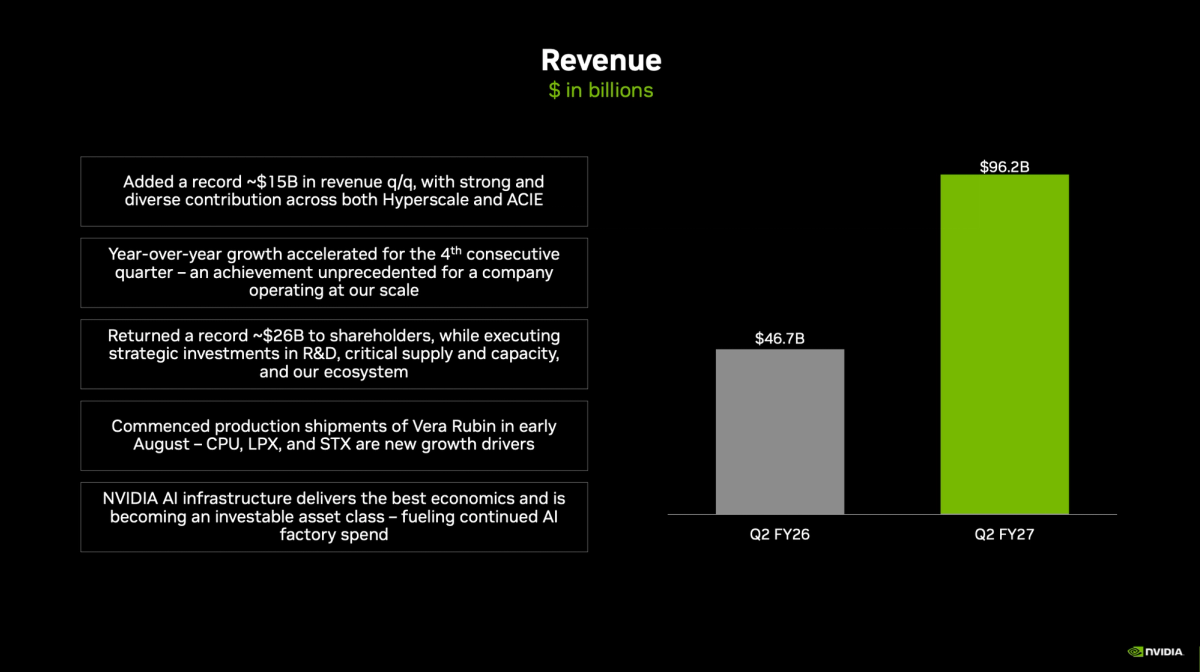
- Revenue: $96.2 billion, up 18% sequentially and 106% year over year, versus the $92.2 billion LSEG consensus
- Adjusted earnings per share: $2.22, up 120% year over year, versus $2.10 expected
- Data Center revenue: $89.0 billion, up 18% sequentially and 117% year over year, versus $85.1 billion expected
- Adjusted gross margin: 75.0%, compared with 72.5% a year ago
The Wall Street comparisons are based on LSEG estimates reported by Reuters.
Data Center growth was not limited to hyperscalers:
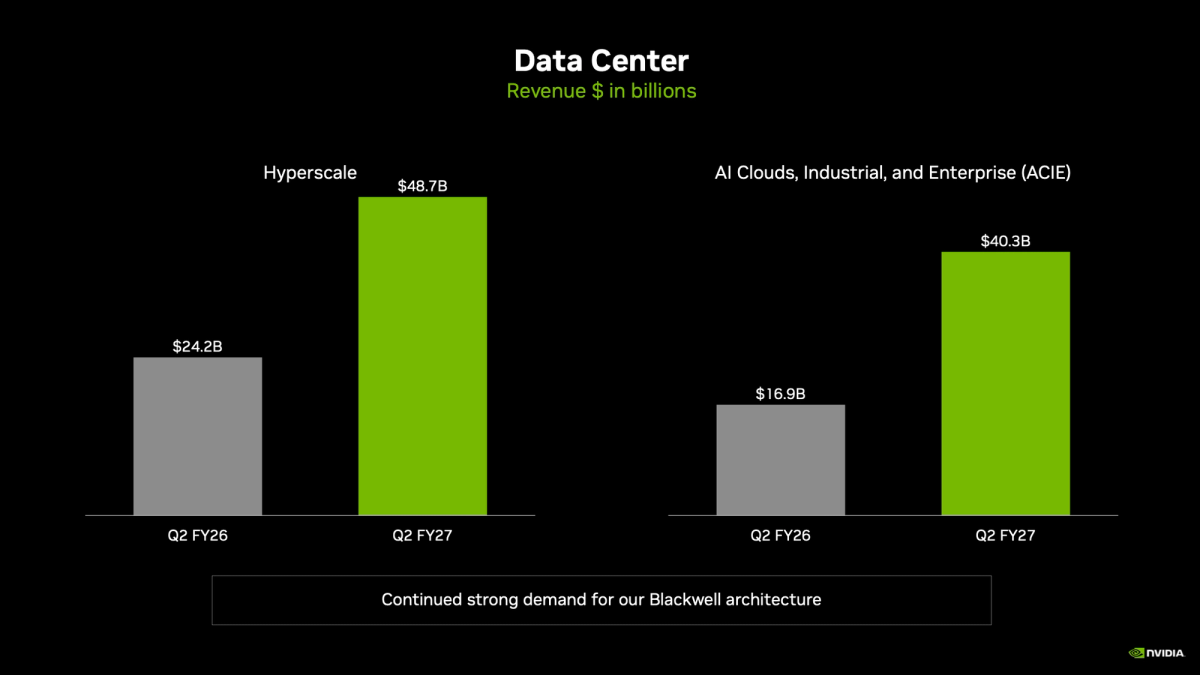
- Hyperscale revenue: $48.7 billion, up 13% sequentially and approximately 102% year over year
- AI Clouds, Industrial and Enterprise revenue: $40.3 billion, up 25% sequentially and 138% year over year
Hyperscalers still represent slightly more than half of Data Center revenue, but the faster growth came from Nvidia's other customer group. In dollar terms, the two groups contributed similar amounts of year-over-year growth, giving Nvidia two comparably large Data Center growth engines.
The outlook changed the stock reaction
Nvidia's third-quarter outlook was stronger on revenue and weaker on margins:
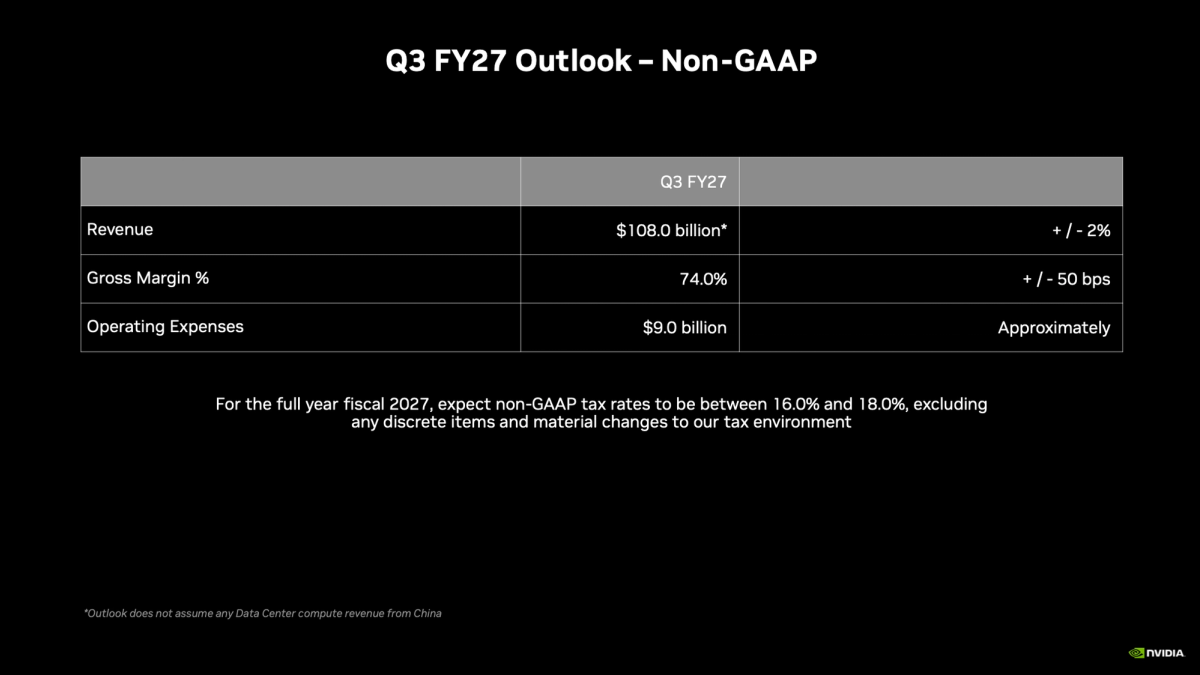
- Revenue: $108 billion, plus or minus 2%, compared with the $104.2 billion LSEG consensus and up approximately 89% from the year-ago quarter at the midpoint
- Gross margin: 74.0%, plus or minus 50 basis points, down from 75.0% in the reported quarter and below the 74.8% Wall Street estimate
- China: No Data Center compute revenue is assumed in the outlook
The preliminary fiscal 2028 outlook went much further. Nvidia does not normally look this far ahead, yet management expects revenue to grow about 70%. CEO Jensen Huang explained the unusual decision on the company's earnings call:
"Even though our demand is much greater than 70%, our supply allows us to confidently deliver 70%."
Management is presenting this as a supply-constrained outlook. In other words, Nvidia says customer demand already exceeds what it expects to deliver, leaving chips, memory, power and other infrastructure as the limiting factors.
The expanded AWS agreement gives that outlook a major customer commitment behind it. AWS plans to deploy 2 million additional Blackwell Ultra, Rubin and Rubin Ultra GPUs across its global infrastructure in 2027 and 2028. The companies also plan to add Nvidia's Vera CPUs and expand their work in networking, models and robotics software.
Production shipments of Vera Rubin began in August. Management expects Rubin to account for about 20% of Data Center revenue next quarter and says it could be the fastest product ramp in Nvidia's history.
The quarter was not clean
The initial sell-off makes more sense when you look at the expected margin path:
- Second quarter: 75.0% adjusted gross margin
- Third quarter: 74.0%, plus or minus 50 basis points
- Fourth quarter: Expected to bottom between 71% and 72%
- Fiscal 2028: Expected to settle between 72% and 73% as price increases take effect
On the earnings call, management blamed what it called "extreme pricing conditions in memory". Nvidia can keep growing rapidly while earning slightly less gross profit from each dollar of sales, but the expected recovery depends partly on price increases that have not yet flowed through the reported numbers.
Nvidia's investments, guarantees and other support for AI labs and infrastructure projects also deserve attention. Management expects customers for which it plans to use its balance sheet to contribute roughly one-quarter of next year's business. Nvidia argues that its compute can be redeployed if a customer runs into trouble, but the scale of these relationships makes customer credit quality and cash conversion more important than they are with investment-grade hyperscalers.
What it means for Nvidia investors
The central question after this report is no longer whether Nvidia has enough demand to support another year of rapid growth. Based on management's preliminary outlook, the harder questions are how much supply it can secure and what that growth will cost as memory prices rise, Rubin ramps and Nvidia puts more of its balance sheet behind parts of the AI ecosystem.
Wednesday night's reaction suggests investors were willing to look past the near-term margin decline once Nvidia provided a much higher forward revenue path and a large AWS commitment. The next few quarters will show whether the company can convert that demand into the 70% growth it expects without allowing margins or customer financing risk to weaken the economics.
For more detail on Nvidia's financials, valuation, margins, analyst expectations and latest company updates, explore the complete Nvidia research section on Stock Unlock.